RESURRECTION
New Group Is Breathing Life Back Into Terre Haute
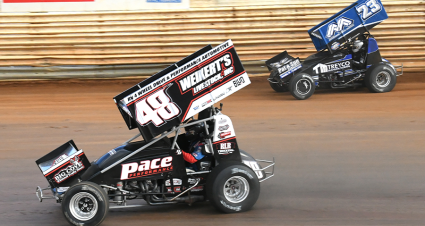
Shane Cottle hooks the Edison No. 10e around Terre Haute during a USAC Sprint race last season. (David E. Heithaus photo)
NSSN Correspondent
TERRE HAUTE, Ind. — It’s a new day for the Terre Haute Action Track. The official announcement came in late February, but the word had been out on the streets for some time already. After months of rumors and speculation, a new group, DHK Promotions, was busy preparing the historic half-mile oval for racing.
Few racing venues are as deeply rooted in American racing history as the Action Track. Built at the Vigo County Fairgrounds in 1949, the first race winner was Joe James. For nearly 50 years, the Action Track was a regular stop for short-track racers touring the country. Organizations likeAAA, USAC and the World of Outlaws visited each year.
But in recent years, the Action Track had fallen on difficult times and in 2007, the action stopped altogether. Under a succession of different promoters, attendance had dwindled, most sanctioning organizations stopped running at the track and only a handful of races were scheduled. Last year’s first event, featuring USAC sprint cars, was concluded prematurely by the track promoter and soon after, USAC canceled its races at the track.
![]() |
| ACTION TRACK: Rich Vogler leads Bob Kinser in 1981. (David E. Heithaus Photo) |
For half a year, rumors that the fair board had sold the fairgrounds ran rampant. Many were convinced they had seen their last race at the venerable oval. But then, for racing fans, a miracle occurred.
DHK Promotions faces an uphill battle on many fronts. Comprised of Brian Dorsett, a former professional baseball player and local businessman, Indy 500 veteran Davey Hamilton, Mike King, the radio announcer for the Indy 500, the Indy Racing League and one-time Action Track announcer, DHK is already making great strides. Leveraging from the experience of each, they have begun readying the spectator areas, scheduling events and mobilizing local businesses to partner with this endeavor. It’s all part of a plan to keep the track safe from land developers, who have surrounded the fairgrounds with shopping malls and restaurants.
“We have a three-year deal with the Wabash County Fair Board. We are hoping for the best,” Dorsett said. “We’re hoping that the success that we bring is going to elevate the way that the fair board looks at it. Even if they do decide to sell some day, we feel like we’re going to be able to have a renewable long-term lease. I think they’re going to like the success that we have. I think it’s going to be great for the community.”
Yet, having seen the paltry attendance of recent seasons and the decline in the condition of the facility, one may wonder why they think they can be successful when others have struggled.
Dorsett begins by pointing to the success that the track experienced during the six-year tenure of T.H.A.T. Racing through much of the ’90’s. “They did a great job. I think that the key has been to have local folks in charge,” he explains. “We’ve got a completely different format, a recipe if you will, for success here, to get it off the ground the right way.”
![]() |
| RETURN VISIT: Robert Ballou lifts the wheels off the track during Midwest Sprint Car Series’ 30-lap Don Smith Classic at Terre Haute May 4, the first event at the track since early 2007. (Phil Rider Photo) |
In addition to being a highly successful racer, Hamilton’s family has operated Meridian Speedway near Boise, Idaho, for more than 20 years. He has also managed several racing groups.
“I think that the biggest thing that I am going to try to bring is organization,” he says. “We’re used to it. Our track (Meridian) is pavement — that’s dirt — so as far as the competition side of it, that’s different. But working with sanctioning bodies and insurance, all of the things that you have to do to run a facility are the same, basically.”
Another ingredient in the recipe has been their ability to involve local businesses. Clabber Girl has lent its support, McAllister Machinery is providing equipment and operators for working the track. Indiana State University is involved through its motorsports curriculum.
The group has already been busy making repairs, improving the fencing and repainting. And with Hall of Fame racer Bubby Jones as a consultant, the track itself is receiving a lot of attention.
“We are moving clay around, we’re moving the track, the dirt, to where it’s going to be even, the way it should have been for years. We’re going to get it back to the great race dirt that it’s always been known for,” Dorsett explained.
They also expect several innovative ideas to pay big dividends. Forgoing a weekly program, this year’s schedule is limited with a focus on big events, including USAC’s Hut Hundred, Sumar Classic Silver Crown race, Hulman Classic and the All Star winged sprint cars. Each will focus on only the featured racing without any support classes.
And, Hamilton (who plans to race a modified at Terre Haute in September) adds, they intend to pit cars in the infield. “Like the good old days, we feel that the fans not only come to see a race, they come to be entertained. They want to look down into the pits and see what’s going on down there. We’re definitely going to put the competitors back into the infield.”
It clearly is a new day for the Terre Haute Action Track. While they still face many obstacles, the approach adopted by King, Hamilton and Dorsett gives this valuable racing venue a shot at returning to the prominence that it once held.
“It’s pretty special,” Hamilton said. “Bringing it back to life, the same place that had all of the famous names — the Bettenhausens, the Foyts, the Vukovichs, the Carters and on and on. Bubby Jones has won there.
“There are just so many people that have had success at that race track. I haven’t talked to a driver yet that’s raced there that said that the place was no good. They all said, ‘man we love that place.’ There’s something special about it. Bringing it back to life, that’s the satisfaction for me.”